
Annapurna Bhandar Eligibility Criteria: Who Can Apply?

Verify residency, age, and background criteria before applying. Review the requirements and use our interactive calculator for quick assessment.

Diverse group of Indian women representing eligibility

Who Can Apply?

The Annapurna Bhandar Scheme is designed to support female heads of families residing in West Bengal. To qualify for the monthly cash assistance of ₹3,000, applicants must meet the basic criteria established by the Department of Women and Child Development. Review the general parameters on our Annapurna Bhandar homepage before proceeding.

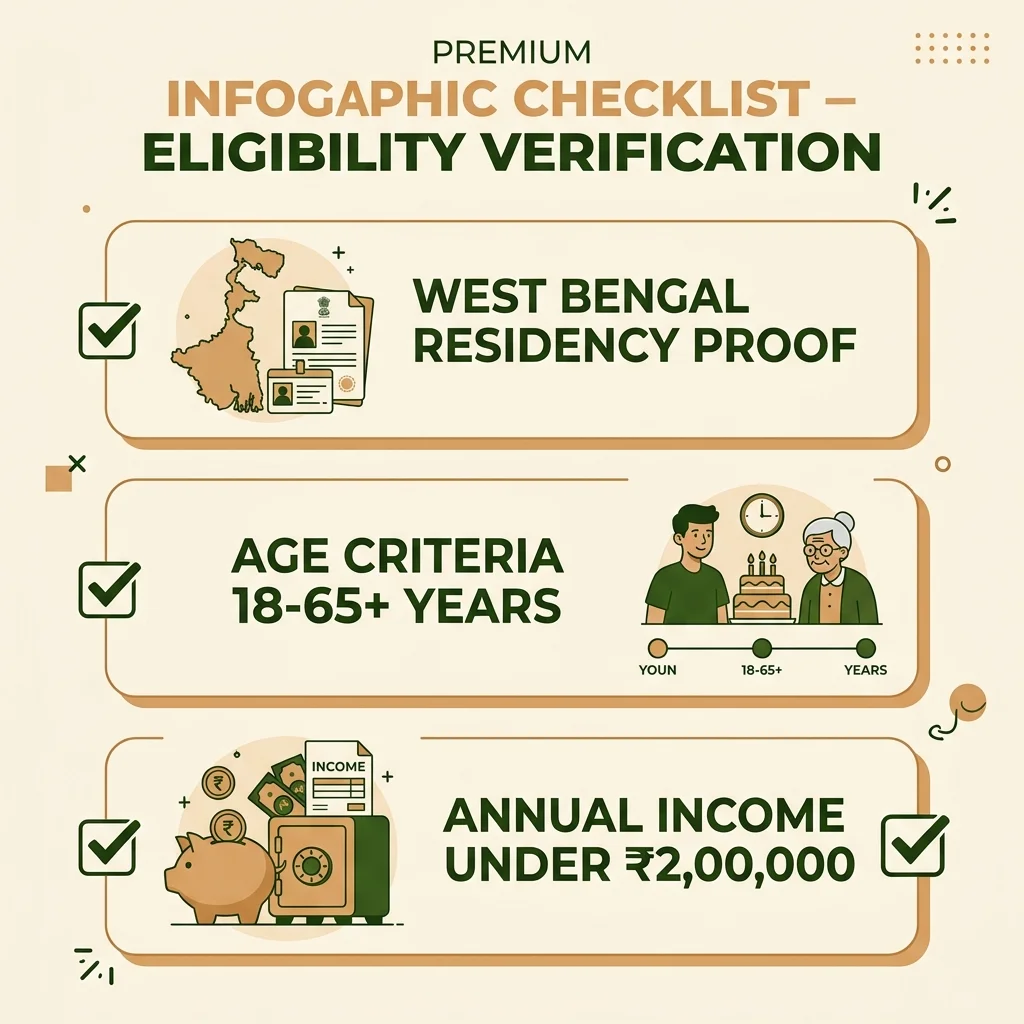
Annapurna Bhandar Eligibility Checklist: Residency, Age, and Income Rules

Age Requirement (18+)

Applicants must be at least 18 years old at the time of registration. The scheme does not set an upper age limit, meaning elderly women and widows can apply as long as they meet other guidelines. The system verifies age records against the applicant's Aadhaar card. Ensure your birth year matches UIDAI records before portal submission.

If the applicant is near the age threshold, block development officers may request school certificates or birth records to verify details. Outdated age registrations must be updated at local service centers to prevent automatic application locks during central review phases.

Verification is done securely using UIDAI vaults. Ensure that your mobile number is active to receive OTP verifications during the application process.

West Bengal Residency

The applicant must be a permanent resident of West Bengal. Residency is verified using official documents, such as a Voter ID card (EPIC) or long-term address proofs. Temporary residents or seasonal workers from other states are not eligible to register under these guidelines. Address data is checked against local revenue land records.

Applicants must have lived in the state for a minimum of five years. If your family card was registered in another state, you must request a record transfer to West Bengal and submit local residency certifications before initiating your online application.

A residency certificate signed by the municipal ward officer or block panchayat head is mandatory. Digital address verification helps check matching details.

Indian Citizenship

Applicants must hold valid Indian citizenship. The state registry checks database entries to prevent duplicate applications across states, ensuring that benefits are processed directly for qualifying citizens. Any discrepancy in address or identity proofs will flag the account during registry checks.

Citizenship claims are validated against Voter ID records (EPIC) and family registry systems. Non-citizens or individuals with pending residency verifications are not eligible to apply. Ensure details are fully updated to maintain processing speed.

Refugee or migration certificates must be submitted if your birth year was registered outside India, keeping database logs clear of security flags.

Bank Account Requirement

Applicants must have a single bank account in their name. Joint accounts are not accepted for direct transfers, as the Public Financial Management System (PFMS) requires matching account names. Seeding your account with Aadhaar is mandatory. Refer to our required documents list for details.

The account must remain active with regular transactions. If a bank account is dormant or locked, the monthly direct benefit transfer (DBT) will fail, triggering registry holds. Open a single savings account at commercial or cooperative banks to ensure smooth routing.

Double check that your name matches spelling details on your digital ration card exactly. If you have joint accounts, open a single savings account to avoid rejections.

Who Cannot Apply?

Certain households are excluded from the scheme to ensure funding is targeted toward families who need it most. Exclusions are verified during the review process using government databases.

Government Employees

Women who are employed in permanent positions in central, state, or local government bodies, or whose spouses hold such positions, are not eligible. This includes regular salary earners in public sector undertakings, government-aided schools, and local civic bodies, ensuring benefits reach non-salaried households.

This exclusion also applies to active government contractors and spouses receiving public service pensions. The state database cross-checks applications against payroll logs to identify and exclude high-security income earners automatically.

If your husband or family member is a regular state worker, the household is excluded from the benefit grid. Declarations are verified against active treasury databases.

High Income Earners

Households with an annual family income exceeding ₹2,00,000 are excluded. Self-declarations are verified against income statements issued by competent block authorities, protecting the integrity of the program. Income statements must be updated and match current revenue database files.

If family members own commercial assets, vehicles, or large agricultural land holdings, the household is classified as high income. BDO review teams inspect land records to verify that support targets low-income families requiring welfare.

If your household income shifts above the threshold, you must notify the BDO office to update registry files, keeping social support matching eligible families.

Non-Residents

Citizens who reside outside the boundaries of West Bengal, or who hold active residency cards in other states, are not eligible to register. Address mapping checks are processed strictly using Voter ID records and block address registries to prevent multiple registrations.

If your active mobile number is registered in another state's telecom circle, the portal may flag your file for residency review. Use a West Bengal circle mobile number and link it to local addresses before submitting application forms.

If you live in neighboring states for work, you must prove active residency in West Bengal to qualify, providing utility bills or local address proofs.

Multiple Applications

Only one female head per household family card can register. Duplicate submissions from the same family unit will cause review delays or rejection. If multiple applications are submitted from one family, local welfare officers will contact the household to select the primary applicant.

The social registry registry maps family units using the digital ration card database. If two or more women list the same ration card number, the IT portal holds both applications, requiring manual block resolution.

Central IT databases run automated checks weekly to detect duplicate records. Submitting multiple files will lock the family ID card until local reviews resolve it.

Income Criteria

The scheme targets low-income families, requiring proof of household income. Verifications are processed through local administrative blocks during Duare Sarkar camps.

Income Thresholds

The annual family income must be under ₹2,00,000. This threshold applies to all communities, with general category applicants verified strictly against tax records and income statements to ensure fair resource allocation.

The income rule is designed to prioritize households facing severe economic strain. Any family member paying active professional income tax is automatically excluded from the recipient database checks.

The income certificate must match the family's annual tax returns. If any family member is a taxpayer, the application is held automatically.

Family Income Calculation

The calculation includes cumulative earnings from all members of the household, including agricultural trade, businesses, and private salaries. Detailed guidelines are available on our scheme details page.

Earnings from seasonal labor, retail shops, and crop sales are computed. The block welfare cell inspects declarations against local land logs to verify family income claims before releasing approvals.

Income from livestock, dairy, and local craft business must be declared. BDO officers check declaration fields against local business registers to verify entries.

Documentation Required

Applicants must provide a verified income certificate issued by a block officer or local Panchayet/Municipality. Ensure the certificate is current and matches your family card records. Outdated statements will cause verification holds.

The certificate must be signed by competent revenue authorities and dated within the last six months. Upload clear scans under 500 KB to avoid portal errors during form submissions.

The scanned files must be uploaded in clear PDF format. If documents are blurred, the reviewer will flag the file for manual correction at camps.

Marital Status & Special Cases

The scheme is inclusive and accommodates women in various family circumstances. Payouts are directed to support women across different marital states.

Married Women

Married women can apply as the head of their household, provided their husband's income does not exceed the threshold and they meet the general guidelines. The application maps the family card to verify details and family relationships.

The husband's name and identity details must be declared on the registry form. The system checks these details against state databases to ensure the household is eligible and no duplicate claims exist.

If the husband has a taxable income, it will be added to the household calculation. Make sure your husband's voter ID details are ready for verification checks.

Widows & Divorcees

Widows and legally divorced women are eligible. They can register as single heads of households, submitting death certificates or legal documents during verification to update registry records, ensuring critical financial security.

A copy of the husband's death certificate or official divorce decree must be scanned and uploaded. This updates the social security profile, matching the applicant to vulnerable welfare support tiers.

The widow pension must not be active, as multiple pension benefits are not allowed. Check with your local block desk to verify pension rules.

Single Women

Unmarried women over the age of 18 who manage independent households can apply under general social registry guidelines, provided they meet income and residency parameters, supporting their economic independence.

The applicant must be listed as an independent head on their digital ration card. Volunteers at Duare Sarkar camps assist single applicants with updating card profiles before portal submissions.

If you live with your parents, your household income must remain below the threshold. Single applicants are verified strictly to ensure fair resource allocation.

Separated Women

Women living separately from their spouses can apply. Local panchayat or block welfare officers verify their household status to process their registration, ensuring support reaches those in need without delay.

Physical verification by block officers confirms the separate living status. Once verified, the registry updates the applicant's profile to allow independent benefit routing, bypassing husband data.

A separation certificate signed by the panchayat chief or municipal cell is required. This document validates independent household status during audits.

Aadhaar & Bank Account Requirements

The database uses Aadhaar-seeded accounts to process payouts securely, reducing transaction issues and ensuring funds reach beneficiaries directly. By linking Aadhaar, the state guarantees that welfare assets land safely in matching single bank ledgers without third-party delay.

Aadhaar Linking

Your Aadhaar Card must be linked to your bank account. Verification checks are executed using NPCI mapper nodes, which direct payments to the linked account. If your account is not seeded, payouts cannot be completed.

Aadhaar linking is checked automatically by PFMS portals. If the bank ledger does not map to your 12-digit Aadhaar number, treasury releases will reject the transaction, causing payment failures.

Bank Account Details

The bank account must be single and active. Joint accounts are not accepted. Ensure the bank ledger matches your Aadhaar details exactly. Inactive bank accounts will cause direct transfer failures.

Spelling differences in your name will flag the bank check. Open a single savings account matching Aadhaar details. Update your IFSC details with your bank if branches merged recently.

How to Link Aadhaar

To link your Aadhaar, visit your bank branch and submit a seeding form, or use your bank's net banking portal. Dial *99*99*1# from your mobile to verify seeding status. Update IFSC for merged branches before linking.

seeder updates typically clear within 48 to 72 hours. Once linked, verify seeding logs via the UIDAI portal or status tool before starting your Annapurna Bhandar online registration.

Eligibility Checker Tool

Use our interactive calculator tool to check if you qualify for the ₹3,000 monthly scheme payments. Input your details below for a quick assessment.

Must be 18 or older.
Limit is ₹2,00,000.

Common Eligibility Questions

Review answers to common questions about eligibility. For more details, visit our FAQ page.

Other Benefits

Q: Can I apply if I receive other government benefits?
A: Yes, eligible women can receive the monthly payout, provided they do not hold government jobs or receive public service pensions. Normal agricultural or student grants do not exclude you from applying.

Student scholarship transfers or housing scheme benefits do not block eligibility. Only regular salary incomes from government bodies or active retirement pensions affect qualifying status checks.

Joint Accounts

Q: What if my bank account is a joint account?
A: Joint accounts are not accepted. The PFMS transaction system requires a single account in the applicant's name to process transfers. Visit your bank to open a single account before applying.

Even joint accounts held with children will fail treasury validations. Open a single savings account at a commercial branch to avoid automatic payment locks and registry review holds.

Beneficiary Change

Q: What happens if the registered beneficiary passes away?
A: If the registered beneficiary passes away, the family can request a transfer of benefits to the next oldest eligible female head, submitting necessary documents to the block office for review.

Submit the death certificate and updated ration card details to the local BDO office. Review teams will verify the new applicant's eligibility before transferring the profile details.

How to Verify Your Eligibility

To verify your status, check your documents against the program guidelines. You can submit inquiries to local block offices or contact official support channels listed on our contact page.

Duare Sarkar Verification

For official verifications, visit local Duare Sarkar camps with physical copies of your documents. Helpdesk officers will verify your details and update your registry profile, ensuring a transparent process.

Officers scan documents, check Aadhaar linking status, and assist with spelling corrections on-site. This is a reliable path for rural applicants to verify details before portal submission.

Central Database Sync

The state social registry maps database entries against active tax rolls and demographics. Ensure that all submitted certificates are current. Mismatched details will delay processing.

Registry nodes check declarations against income logs automatically. Mismatched family card details or income statement inputs will hold application files, requiring manual review updates.

Block Office Support

If your online checker status is flagged, contact your block development officer or municipal desk. Support staffs assist with resolving mismatches and submitting correction forms.

Help desks check BDO registry databases to specify reason details for review holds, assisting applicants with submitting correct certificates to unlock their monthly transfers.