

Annapurna Bhandar Application Status Tracker

Track your processing state, block-level verification reviews, and direct bank transfer schedules by entering your reference details below.

Indian woman checking her payment status on a mobile app dashboard

Enter Application Tracking Details

You can search using your unique Application ID, 12-digit Aadhaar Card, or registered Mobile number.

Format: AB-2026-XXXXXX, or 12-digit Aadhaar, or 10-digit mobile number.

Why Track Your Application Status?

Tracking your Annapurna Bhandar Scheme status is important to ensure your application moves through the verification process. The Department of Women and Child Development operates a digital registry, and identifying any errors early helps resolve issues quickly. Review the general program structure on our welfare homepage for context.

The state database integrates registration records with the central beneficiary list to cross-verify family size and income limits. If verification checks stall due to minor discrepancies, candidates receive automated messages. Checking status records regularly online ensures your file is processed on schedule, avoiding payment delays.

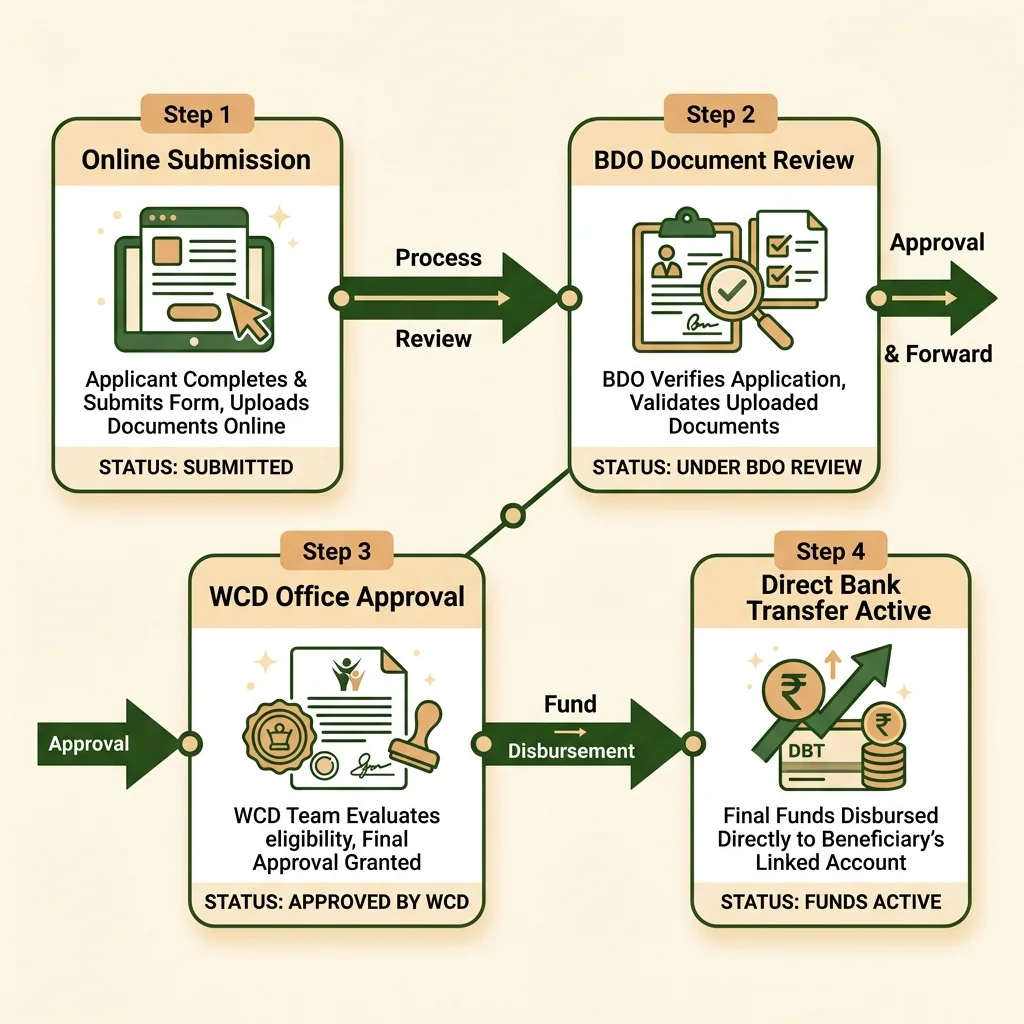
Annapurna Bhandar Application Tracking Milestones: Submission, BDO Audit, WCD Central Sweeps, and DBT Bank Active

Payout Security Check

Regular status checks confirm that payouts are routed successfully. If a transaction fails due to bank merging issues or dormant accounts, the portal updates the transfer log to help you troubleshoot the problem. This tracking trail helps ensure that financial support reaches approved recipients directly without delays.

Through direct portal monitoring, you can audit transaction reference numbers, ledger dates, and bank response messages, bypassing the need to visit local desks repeatedly. This secure transparency reduces processing anxiety and establishes trust in government programs.

The transaction log displays bank codes and settlement dates. In case of payment issues, this information helps bank operators trace the funds quickly.

Household Budgeting

A guaranteed monthly payout helps low-income families manage daily costs and food inflation. By monitoring your application progress, you can confirm when payments are scheduled, reducing financial delays. This regular cash flow supports family planning, savings, and local purchasing power.

Knowing the exact date of benefit releases allows mothers to manage children's tuition dates, buy groceries during discount cycles, and deposit micro-savings into local self-help group accounts. It transforms erratic family budgets into structured systems.

Predictable cash flow allows mothers to plan domestic purchases. Stable cash transfers support household savings and prevent reliance on emergency loans.

Registry Accuracy

The state database processes registrations through local administrative blocks. By checking your status regularly, you can monitor block reviews and ensure details match across platforms. If details do not match your Aadhaar, local development officers will place your file on hold for biometric checks.

Mismatched details in name spelling or digital ration cards are flagged automatically by central validation systems. Checking the tracking status allows you to identify these flags early and upload current documents to resolve review holds.

If block reviewers find discrepancies, they will update the online logs. Checking comments regularly helps you submit corrections on time.

Communication Logs

The portal lists detailed comments from block development reviewers. If your application lacks documentation or features a spelling error, details are specified on your ledger. Tracking your status allows you to see these administrative comments immediately.

If block reviewers require an updated income certificate or a clear bank book scan, the communication log details the requirements. This allows you to resolve issues directly without waiting for physical postal notifications.

The system records notes from review officers at BDO offices. Reading these details helps you compile the exact documents required to unlock your file.

Detailed Steps to Check Payout Status Online

The online tracking system is designed to provide transparent access to your file status. Follow these steps to query the registry database:

The online tracking system is designed to provide transparent access to your file status. Beneficiaries can query the database directly from any smart device. Verification databases are updated in real-time, allowing you to trace your file progress from submission to bank settlement. Follow these steps to query the registry database:

Step 1: Accessing the Registry Portal

Navigate to the official portal at socialregistry.wb.gov.in. Make sure you use a secure connection and verify the website domain before inputting details. Avoid third-party portals that request processing fees or require logins. Official access is free for all citizens.

Ensure your web browser is updated to prevent screen freezes on database dashboards. Accessing the portal during low-traffic off-peak hours (early morning or late evening) guarantees fast page responses and registry query parsing.

Keep your credentials confidential. The official web workspace provides free access to check transaction histories and account details.

Step 2: Entering Verification Parameters

You can search using your Application ID, registered mobile number, or 12-digit Aadhaar number. Input these details into the search field to retrieve your records. The system parses entries against active database records and displays transaction logs or reviews.

The search field accepts multiple format types to make tracking accessible. Keep your unique reference code (e.g. AB-2026-991283) or Aadhaar card close by before starting the search query to ensure quick inputs.

Make sure to type number strings correctly. Mismatched digits prevent the system from loading your status logs, triggering search errors.

Step 3: Authenticating with Mobile OTP

The portal verifies your credentials against state registry records. In some cases, a security OTP is sent to your Aadhaar-linked mobile number to verify your identity. Enter the code to unlock your detailed payout history, ensuring secure database access.

The OTP verification acts as a security lock, preventing unauthorized people from viewing your banking and address logs. If you do not receive the SMS within two minutes, request a resend code from the portal panel.

If the OTP fails, wait for a few minutes before clicking resend. Mobile networks can experience congestion during high-traffic cycles.

Step 4: Viewing Payout Log Details

Once logged in, you can view the transaction ledger detailing the payout date, transaction reference number, bank branch info, and routing status. For a complete guide on preparing verification files, check our step-by-step application guide.

If payments are listed as settled, check your bank passbook to verify the deposit. If listed as failed, read the error status message to determine if bank seeding updates or branch code corrections are required to unlock transfers.

The ledger lists complete details including payment dates and amounts. Keeping screenshots of successful payouts helps maintain personal records.

Deciphering Your Status Report

Upon querying the database, the portal displays one of several status labels. Review the common status results and their meanings:

Upon querying the database, the portal displays one of several status labels. Each label corresponds to a specific review milestone inside block offices. Understanding these terms helps candidates identify if manual action is required at local helpdesks to update files. Review the common status results and their meanings:

Status: Under Review

Your application is currently undergoing demographic checks by local block offices or municipal cells. This review typically takes 15 to 30 working days. The system matches details against residency and income databases to verify eligibility before routing to the PFMS database.

During this phase, officers cross-check your income certificates and digital family cards. If details are correct, the status updates to approved. Monitor the status online weekly to track reviews.

The block administration cell checks declarations against tax records. Regular weekly tracking helps you monitor the progress of these validation checks.

Status: Approved & Active

Your application is verified, and bank mapping checks are complete. Payouts are active and will be deposited during the first week of each month. A confirmed status indicates that bank account linkages match active records, showing you will receive ₹3,000 monthly.

This status means the state IT systems have synced your account to the Aadhaar Payment Bridge. No further action is required from you, and payments will proceed automatically each calendar month.

Congratulations, your file is confirmed. The state treasury will route payouts directly to your seeded bank account in monthly batches.

Status: Action Required / Suspended

The review flagged a discrepancy, such as a name mismatch or an outdated bank code. You must upload corrected documents to reactivate your file. Refer to our required documents checklist for formatting guidelines and BDO helpdesk locations.

Common reasons for suspension include using joint accounts or inputting old bank branch details. Upload clear document scans or visit a local camp to submit updates, correcting flags immediately.

If your file is suspended, submit corrected documents to local block offices. The review team will verify the updates and reactivate your account.

Status: Disbursed & Settled

The payment has been successfully initiated by the state treasury and routed to your bank via DBT. The ledger lists the transaction reference and bank settlement stamp. Verify your bank passbook ledger to confirm the deposit has cleared successfully.

If the ledger lists settled but funds do not appear in your account, visit your bank branch to check if seeding logs are active. NPCI mapper delays can sometimes delay bank clearance stamps by 24 hours.

Verify the funds at your bank branch. The bank ledger will display the transfer with the state welfare registry's payment stamp.

Troubleshooting Status Errors

If your status indicates a processing issue, follow these steps to resolve common database discrepancies:

If your status indicates a processing issue, follow these steps to resolve common database discrepancies. Automated sweeps run by the state treasury cell flag bank account issues or matching errors. Resolving these issues early ensures that direct bank transfers resume without administrative holds. Review solutions below:

IFSC Merge Mismatch

If your bank branch merged recently (e.g. Allahabad Bank into Indian Bank), update your IFSC records. Visit your branch or submit a correction form online to update your details, ensuring direct benefit transfers are processed successfully without payment drops.

Outdated branch codes will cause automatic transaction rejections at treasury nodes. Submit a bank passbook update showing the active branch codes to BDO helpdesks or camps to reactivate your payment logs.

Your bank will provide the new routing code. Seeding this new code on the portal ensures that subsequent payouts are routed correctly.

Aadhaar Seeding Issues

If the ledger flags an NPCI mapping failure, your bank account is not seeded with Aadhaar. Visit your bank branch and submit an NPCI seeding form. Payouts are routed via the Aadhaar Payment Bridge, making Aadhaar seeding mandatory for monthly deposits.

Check seeding status by dialing *99*99*1# from your mobile. If status checks show seeding is inactive, request the bank to map your Aadhaar to your account to allow direct treasury transfers.

You can submit a seeding request at the bank branch or via mobile banking apps. Valid seeding status is required to receive state transfers.

Biometric Lock Errors

Active biometric locks on your Aadhaar card can block registry scans during review. Temporarily unlock your biometrics via the mAadhaar app or visit an Aadhaar Seva Kendra to allow verification checks during block reviews. Re-lock after approval.

Biometric holds prevent local officers from querying identity databases, stalling reviews. Temporarily disabling the lock ensures that state security portals can verify demographic details and approve profiles.

Keeping locks disabled during review is crucial. Biometric checks are run by block officers to verify legal identity records.

Mobile Number Mismatch

If you do not receive status OTPs, your registered mobile number is outdated. Visit a Duare Sarkar camp or municipality helpdesk to submit a mobile change request. For more details, browse our frequently asked questions page, or view our contact page.

Mobile changes must be signed with biometric consent templates. Bring your original Aadhaar and mobile to local camps, where volunteers assist with updating numbers in the social security database.

The mobile change requires physical verification. Volunteers at Duare Sarkar helpdesks assist candidates with these update forms free of charge.

Administrative Verification Milestones & Offices

The status tracking sequence corresponds directly to specific review stages managed by local and state administrative offices. Each verification block performs auditing checks on your submitted documents to ensure compliance before authorizing financial routing.

The status tracking sequence corresponds directly to specific review stages managed by local and state administrative offices. Each verification block performs auditing checks on your submitted documents to ensure compliance before authorizing financial routing. By understanding which office holds your application file, you can contact the correct desk to submit corrections if reviews flag issues. Review details below:

Gram Panchayat Level Audits

The initial stage of validation begins at the Gram Panchayat or municipal ward level. Local verification teams check residency certificates, family card structures, and demographic records on-site to ensure compliance. If details are confirmed, the files are uploaded to the block-level digital database queue.

Local volunteers cross-check references with village registers to confirm that the applicant resides at the declared address and meets physical verification rules. If discrepancies are found, the portal updates status comments, prompting applicants to present physical documents.

This ground-level review ensures that only qualifying residents are registered in the system. The local verification officers sign off on the files before submitting them to the Block Development Office.

BDO Verification Reviews

The Block Development Officer (BDO) is the primary clearance authority for all registrations. BDO cells review income certificates, family declarations, and caste categories against state databases. This review is critical to confirm the candidate is eligible for the unified ₹3,000 tier.

During this stage, BDO audit teams verify that the applicant is the unique female head listed on the family card. If secondary applications from the same family are found, reviewers suspend the files, requiring applicants to visit BDO helpdesks to resolve duplicate claims.

Once BDO verification checks are complete, approved files are updated to approved status online and queued for state treasury mapping, certifying that the credentials meet social security rules.

State WCD Registry Sweeps

Approved applications are routed to the central database managed by the Department of Women and Child Development (WCD). State registry systems perform digital runs to match candidate files against tax records, identifying exclusions or pension holders.

This centralized validation prevents duplicate disbursements across different welfare schemes and ensures that funds are distributed correctly. The central server maps the approved database to the Public Financial Management System (PFMS) for bank clearance.

Once WCD registry checks are complete, status updates to active on the dashboard. This shows that the applicant profile is locked in the treasury registry for monthly payment cycles.

Banking Settlement Channels

The final stage is managed by commercial banks and the National Payments Corporation of India (NPCI) network. Treasury nodes initiate DBT payouts, which are routed to the applicant's bank via the Aadhaar Payment Bridge. Cleared deposits are stamped with transaction codes.

If the mapping returns seeding failures, the payment is rejected at banking gates, and the status tracker flags an NPCI mapping error. Beneficiaries must then submit Aadhaar seeding forms at their branch to reactivate payouts.

Successful settlements are recorded on the portal, listing the payment reference, bank branch, and transaction date. Beneficiaries can check their passbook to confirm the credit.